


Tuesday, January 01, 2008
Saturday, December 15, 2007
Sunday, December 11, 2005
Friday, August 19, 2005
GOD
We worship the one only living and true God who is revealed in the Bible and who is
the source of all life, glory, goodness, and blessedness.
Trinity.
With the holy catholic church in all ages, we confess the mystery of the holy
Trinity—that there is one God alone, infinite and eternal, Creator of all things, the
greatest good, who is one in essence or nature, yet who exists in a plurality of three
distinct persons—the Father, the Son, and the Holy Spirit.
Creation/Providence/Sovereignty. God in the beginning created the universe and
everything in it for the manifestation of God’s glory, eternal power, wisdom, and
goodness. He is the sovereign ruler of creation, working all things according to the
counsel of his omnipotent and righteous will. In gracious providence God
continually upholds, directs, oversees, and governs creation—all creatures, actions,
and things.
In sovereignty God has seen fit to accommodate free will among moral creatures,
resulting in great cultural and cosmic good and terrible evil, disorder, and
disobedience. Nevertheless, God is in no way the author of evil or sin, but continues
to govern creation in such a way as to cause all things to work together for good for
those who love God and are called according to his purpose. God opposes all evil
and will certainly triumph over it and bring creation to a glorious consummation.
Grace. God is a God of love. In grace God chooses to show love and mercy. When we
were dead in trespasses and sin, God made us alive with Christ, saving us by grace
through faith, as a sheer gift of sovereign love.
Worship. God—and God alone—is worthy of worship. We respond to God by
consciously and intentionally seeking to declare, explore, celebrate, and submit to
God’s righteous and gracious kingship over all of creation and over every aspect of
our individual and corporate life, and thereby “to glorify him and enjoy him
forever.” (Westminster, 7.01) This is true worship.
Do you consider the doctrine of the Trinity an “essential tenet”?
Luke 1:35
35And the angel answered her, "The Holy Spirit will come upon you, and the power of the Most High will overshadow you; therefore the child to be born[a] will be called holy--the Son of God.
Footnotes:
Luke 1:35 Some manuscripts add of you
Nicene Creed 1.1,
We believe in one God,
the Father, the Almighty,
maker of heaven and earth,
of all that is,
seen and unseen.
1.3
We believe in the Holy Spirit, the Lord, the giver of life,
who proceeds from the Father and the Son,
who with the Father and the Son is worshiped and glorified,
who has spoken through the prophets.
We believe in one holy catholic and apostolic Church.
We acknowledge one baptism for the forgiveness of sins.
We look for the resurrection of the dead,
and the life of the world to come. Amen.
Some consider it an archaic or obsolete vestige of an old orthodoxy?
Genesis 1:1
1In the beginning, God created the heavens and the earth.
Exodus 20:4-5
4"You shall not make for yourself a carved image, or any likeness of anything that is in heaven above, or that is in the earth beneath, or that is in the water under the earth. 5You shall not bow down to them or serve them, for I the LORD your God am a jealous God, visiting the iniquity of the fathers on the children to the third and the fourth generation of those who hate me,
What relevance does this doctrine
continue to have, if any?
Romans 1:23; 8:28
23and exchanged the glory of the immortal God for images resembling mortal man and birds and animals and reptiles.
28And we know that for those who love God all things work together for good,[a] for those who are called according to his purpose.
Why do you believe in the doctrine of the Trinity—and why is it
important?
Westminster Confession of Faith 6.011-6.014
Westminster Confession of Faith 6.011-6.014
Of God, and of the Holy Trinity
1. There is but one only living and true God,1 who is infinite in being
and perfection,2 a most pure spirit,3 invisible,4 without body, parts, or
passions,5 immutable,6 immense,7 eternal,8 incomprehensible,9 almighty;
10 most wise,11 most holy,12 most free,13 most absolute,14 working
all things according to the counsel of his own immutable and most
righteous will,15 for his own glory;16 most loving,17 gracious, merciful,
long-suffering, abundant in goodness and truth, forgiving iniquity, transgression,
and sin;18 the rewarder of them that diligently seek him;19 and
withalh most just and terrible in his judgments;20 hating all sin,21 and who
will by no means clear the guilty.22
2. God hath all life, glory, goodness, blessedness, in and of himself;23 and
is alone in and unto himself all-sufficient, not standing in need of any creatures
which he hath made, nor deriving any glory from them, but only manifesting
his own glory in, by, unto, and upon them:24 he is the alone fountain
of all being, of whom, through whom, and to whom, are all things;25
and hath most sovereign dominion over them, to do by them, for them, ori
upon them, whatsoever himself pleaseth.26 In his sight all things are open
and manifest;27 his knowledge is infinite, infallible, and independent upon
the creature;28 so as nothing is to him contingent or uncertain.29 He is most
holy in all his counsels, in all his works, and in all his commands.30 To him
is due from angels and men, and every other creature, whatsoever worship,
service, or obedience he is pleased to require of them.31
3. In the unity of the Godhead there be three Persons of one substance,
power, and eternity: God the Father, God the Son, and God the Holy
Ghost.32 The Father is of none, neither begotten nor proceeding; the Son
is eternally begotten of the Father;33 the Holy Ghost eternally proceeding
from the Father and the Son.34
As an issue of theological integrity and conscience, are you a Trinitarian Christian in the
sense expressed in the Scots Confession (3.01),
the Nicene Creed,
Nicene Creed 1.1,
We believe in one God,
the Father, the Almighty,
maker of heaven and earth,
of all that is,
seen and unseen.
1.3
We believe in the Holy Spirit, the Lord, the giver of life,
who proceeds from the Father and the Son,
who with the Father and the Son is worshiped and glorified,
who has spoken through the prophets.
We believe in one holy catholic and apostolic Church.
We acknowledge one baptism for the forgiveness of sins.
We look for the resurrection of the dead,
and the life of the world to come. Amen.
the Westminster
Confession (6.013), and the Brief Statement (10.1)?
Some theologians have proposed replacing Father, Son, and Holy Spirit with Creator,
Redeemer, and Sustainer or Comforter. Is this a valid reformulation of the Trinity?
Of the world’s major religions, only Christianity seems to be Trinitarian. Other religions
are either radically monotheist (Judaism and Islam) or polytheist (animism, Hinduism). Is
Christianity’s revelation of God fundamentally in harmony with or different from these
other major religions?
?????????????????
1 In the beginning God created the heavens and the earth.
2 Now the earth was [a] formless and empty, darkness was over the surface of the deep, and the Spirit of God was hovering over the waters.
26 Then God said, "Let us make man in our image, in our likeness, and let them rule over the fish of the sea and the birds of the air, over the livestock, over all the earth, [b] and over all the creatures that move along the ground."
the source of all life, glory, goodness, and blessedness.
Trinity.
With the holy catholic church in all ages, we confess the mystery of the holy
Trinity—that there is one God alone, infinite and eternal, Creator of all things, the
greatest good, who is one in essence or nature, yet who exists in a plurality of three
distinct persons—the Father, the Son, and the Holy Spirit.
Creation/Providence/Sovereignty. God in the beginning created the universe and
everything in it for the manifestation of God’s glory, eternal power, wisdom, and
goodness. He is the sovereign ruler of creation, working all things according to the
counsel of his omnipotent and righteous will. In gracious providence God
continually upholds, directs, oversees, and governs creation—all creatures, actions,
and things.
In sovereignty God has seen fit to accommodate free will among moral creatures,
resulting in great cultural and cosmic good and terrible evil, disorder, and
disobedience. Nevertheless, God is in no way the author of evil or sin, but continues
to govern creation in such a way as to cause all things to work together for good for
those who love God and are called according to his purpose. God opposes all evil
and will certainly triumph over it and bring creation to a glorious consummation.
Grace. God is a God of love. In grace God chooses to show love and mercy. When we
were dead in trespasses and sin, God made us alive with Christ, saving us by grace
through faith, as a sheer gift of sovereign love.
Worship. God—and God alone—is worthy of worship. We respond to God by
consciously and intentionally seeking to declare, explore, celebrate, and submit to
God’s righteous and gracious kingship over all of creation and over every aspect of
our individual and corporate life, and thereby “to glorify him and enjoy him
forever.” (Westminster, 7.01) This is true worship.
Do you consider the doctrine of the Trinity an “essential tenet”?
Luke 1:35
35And the angel answered her, "The Holy Spirit will come upon you, and the power of the Most High will overshadow you; therefore the child to be born[a] will be called holy--the Son of God.
Footnotes:
Luke 1:35 Some manuscripts add of you
Nicene Creed 1.1,
We believe in one God,
the Father, the Almighty,
maker of heaven and earth,
of all that is,
seen and unseen.
1.3
We believe in the Holy Spirit, the Lord, the giver of life,
who proceeds from the Father and the Son,
who with the Father and the Son is worshiped and glorified,
who has spoken through the prophets.
We believe in one holy catholic and apostolic Church.
We acknowledge one baptism for the forgiveness of sins.
We look for the resurrection of the dead,
and the life of the world to come. Amen.
Some consider it an archaic or obsolete vestige of an old orthodoxy?
Genesis 1:1
1In the beginning, God created the heavens and the earth.
Exodus 20:4-5
4"You shall not make for yourself a carved image, or any likeness of anything that is in heaven above, or that is in the earth beneath, or that is in the water under the earth. 5You shall not bow down to them or serve them, for I the LORD your God am a jealous God, visiting the iniquity of the fathers on the children to the third and the fourth generation of those who hate me,
What relevance does this doctrine
continue to have, if any?
Romans 1:23; 8:28
23and exchanged the glory of the immortal God for images resembling mortal man and birds and animals and reptiles.
28And we know that for those who love God all things work together for good,[a] for those who are called according to his purpose.
Why do you believe in the doctrine of the Trinity—and why is it
important?
Westminster Confession of Faith 6.011-6.014
Westminster Confession of Faith 6.011-6.014
Of God, and of the Holy Trinity
1. There is but one only living and true God,1 who is infinite in being
and perfection,2 a most pure spirit,3 invisible,4 without body, parts, or
passions,5 immutable,6 immense,7 eternal,8 incomprehensible,9 almighty;
10 most wise,11 most holy,12 most free,13 most absolute,14 working
all things according to the counsel of his own immutable and most
righteous will,15 for his own glory;16 most loving,17 gracious, merciful,
long-suffering, abundant in goodness and truth, forgiving iniquity, transgression,
and sin;18 the rewarder of them that diligently seek him;19 and
withalh most just and terrible in his judgments;20 hating all sin,21 and who
will by no means clear the guilty.22
2. God hath all life, glory, goodness, blessedness, in and of himself;23 and
is alone in and unto himself all-sufficient, not standing in need of any creatures
which he hath made, nor deriving any glory from them, but only manifesting
his own glory in, by, unto, and upon them:24 he is the alone fountain
of all being, of whom, through whom, and to whom, are all things;25
and hath most sovereign dominion over them, to do by them, for them, ori
upon them, whatsoever himself pleaseth.26 In his sight all things are open
and manifest;27 his knowledge is infinite, infallible, and independent upon
the creature;28 so as nothing is to him contingent or uncertain.29 He is most
holy in all his counsels, in all his works, and in all his commands.30 To him
is due from angels and men, and every other creature, whatsoever worship,
service, or obedience he is pleased to require of them.31
3. In the unity of the Godhead there be three Persons of one substance,
power, and eternity: God the Father, God the Son, and God the Holy
Ghost.32 The Father is of none, neither begotten nor proceeding; the Son
is eternally begotten of the Father;33 the Holy Ghost eternally proceeding
from the Father and the Son.34
As an issue of theological integrity and conscience, are you a Trinitarian Christian in the
sense expressed in the Scots Confession (3.01),
the Nicene Creed,
Nicene Creed 1.1,
We believe in one God,
the Father, the Almighty,
maker of heaven and earth,
of all that is,
seen and unseen.
1.3
We believe in the Holy Spirit, the Lord, the giver of life,
who proceeds from the Father and the Son,
who with the Father and the Son is worshiped and glorified,
who has spoken through the prophets.
We believe in one holy catholic and apostolic Church.
We acknowledge one baptism for the forgiveness of sins.
We look for the resurrection of the dead,
and the life of the world to come. Amen.
the Westminster
Confession (6.013), and the Brief Statement (10.1)?
Some theologians have proposed replacing Father, Son, and Holy Spirit with Creator,
Redeemer, and Sustainer or Comforter. Is this a valid reformulation of the Trinity?
Of the world’s major religions, only Christianity seems to be Trinitarian. Other religions
are either radically monotheist (Judaism and Islam) or polytheist (animism, Hinduism). Is
Christianity’s revelation of God fundamentally in harmony with or different from these
other major religions?
?????????????????
1 In the beginning God created the heavens and the earth.
2 Now the earth was [a] formless and empty, darkness was over the surface of the deep, and the Spirit of God was hovering over the waters.
26 Then God said, "Let us make man in our image, in our likeness, and let them rule over the fish of the sea and the birds of the air, over the livestock, over all the earth, [b] and over all the creatures that move along the ground."
Wednesday, August 17, 2005
Thursday, August 11, 2005
Aug 19th meeting: Church
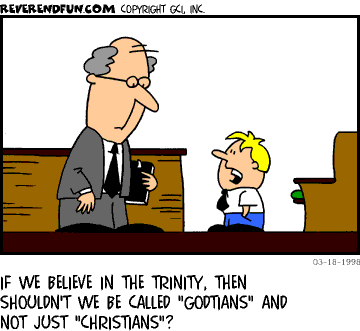
Church blogging
This doesn't fit into "corporate" blogging, of course, but it is all about how an organization can use blogs: 4 Ways Blogging Can Change Your Church (via).
"...a preacher will be able to post a sermon idea at the beginning of the week and have the congregation respond so that when he delivers the sermon he will have brought many along for the ride" the author writes.
4 Ways Blogging Can Change Your Church
A Blog for the Emerging Church
Aug 19th meeting: Education
Blogs in Education:
http://epnweb.org/
storage
http://ourmedia.org/
demo:
Example of an classroom blog
Tufte's Economics Classes Blog
Harvard case study on blogging
Mon, Mar 8, 2004; by Dave Winer.
Trent Lott and the bloggers
A milestone case study from the Shorenstein Center was released on Friday last week. It tells the story of Senator Trent Lott, (R-MS); his talk at Strom Thurmond's birthday party in December 2002, and how the news flowed through professional channels, to the blogosphere, and back, ultimately resulting in Lott's resignation as majority leader of the US Senate.
http://epnweb.org/
storage
http://ourmedia.org/
demo:
Example of an classroom blog
Tufte's Economics Classes Blog
Harvard case study on blogging
Mon, Mar 8, 2004; by Dave Winer.
Trent Lott and the bloggers
A milestone case study from the Shorenstein Center was released on Friday last week. It tells the story of Senator Trent Lott, (R-MS); his talk at Strom Thurmond's birthday party in December 2002, and how the news flowed through professional channels, to the blogosphere, and back, ultimately resulting in Lott's resignation as majority leader of the US Senate.
Tuesday, November 16, 2004
blogroll
-
-
-
http://doc.weblogs.com/
-
http://doc.weblogs.com/2004/11/16#sometimesYouGetLucky
I'm loving the Alexis Park Hotel, because it's providing excellent fodder for my talk tomorrow at Apachecon. (To my Apachecon friends: don't worry; I'll be nice.)
I will say it was great to get away last night to Bellagio, and one of the finest dinners, ever, at Picasso.
Ben Hyde got lucky too. A very attractive woman just ran up to me and told me my lap top is extremely cute! He declined to say if he was talking about a computer...
-
http://doc.weblogs.com/2004/11/16#theShortAnswerIsNo
Sheila Lennon, as so often, nails it with Does the message need the medium?, about the Online News Association event in Hollywood that Dave reported on as well. She runs with the opening remarks of AP chief Tom Curley, the crux of which is this line here:
The franchise is not the newspaper; it's not the broadcast; it's not even the Web site. The franchise is the content itself.
Then there's this set-up...
We are shifting from an old "telegraph" model of pushing news to our subscribers through proprietary pipelines to a database model, where our customers can retrieve what they want, when they want it, over the network....
To which Sheila adds this:
While this may be news to some in mainstream media, I immediately think of Cluetrain's Doc Searls, who hates the term "content." This snip of Doc at a Jabber conference (original link has vanished) explains it,
Hollywood sees the Net as a plumbing system for intellectual property and other content,
Geeks see the Net as a place - a commons - where people can make culture and do business.
Ask, "Who creates this 'content'?" and you've bridged the divide. Ask, "Who finances the creation of this 'content'?" and another problem emerges.
The Jabber source may be gone; but I've said the quoted lines a number of times in a variety of places. Here's a slide with that text, from a 2002 OSCon talk.
The problem, for the APs of the world, is that they can't stop thinking in terms of distribution, of piping, of moving the goods they call "content."
Funny thing about "content." I'll bet that AP didn't call their stories, features and other goods "content" until the dot-commies popularized the word in the late '90s. As John Perry Barlow says, "We didn't start hearing about 'content' until the container business felt threatened."
There are two big problems with the word "content." First, it treats creative works as container cargo, which is demeaning as well as misleading. Second, it denies the creative, transformative and essentially unfinished quality of all creative works. Plus their authority.
Google's PageRank, which organizes search results, doesn't treat linkable goods as "content," but rather as sources. The value of those sources is ranked by authority, determined by pointage from other sources, each of which are also ranked in the same way.
Keep "authority" mind as we revisit something I wrote more than four years ago:
Hackers didn't build the Net for business. They built it for research. They wanted to make it easy for people to inform each other, no matter who or where they were.
Several days ago Tim O¹Reilly and I were talking about information, which is a noun derived from the verb to form. We use information, literally, to form each other. So, if we are in the market for information, we are asking to be formed by other people. In other words, we are authors of each other. It follows that the best information is the kind that changes us most. If we want to know something — if we are in the market for knowledge — we demand to be changed.
That change is growth. Our identity persists, yet who-we-are becomes larger, because we know more. And the more we know, the more valuable we become. This value isn't a "brand" (a nasty word that comes to us from the cattle industry). It's reputation.
What these hackers made was an extraordinarily vast and efficient market for knowledge — a wide-open marketspace for information — where everybody gets to participate, to contribute, to grow, and to increase the value of their own reputations.
That's what's still behind the new ecosystem in which old news organizations need to find a new way.
-
http://doc.weblogs.com/2004/11/16#theWorldLivelierWeb
USA Today has a pile of RSS feeds, on 30 different subjects, with lots of essentially live news flow. Thanks to Big Rick for pointing out the URL, which shows the feeds coming from the marketing corner of the newspaper.
-
http://doc.weblogs.com/2004/11/16#smellsGood
Dave Slusher posts his Podcasting Recipe.
-
http://doc.weblogs.com/2004/11/16#whatItSortofWas
Mark Finnern has located the original artwork for this blog.
-
http://doc.weblogs.com/2004/11/16#wayToGoAgain
After starring at Bloggercon, Julie Leung makes the cover of the local paper at home. Lots of bonus links to other local bloggers in Bainbridge Island.
Wednesday, June 02, 2004
The Confederated Tribes of Grand Ronde Home Page
Tribal Casino Revenues Put to Good Use in Oregon
Once struggling to stay alive after the federal government sold most of its reservation and terminated its tribal status, the Confederated Tribes of Grand Ronde ( http://grandronde.org/ ) today operate one of the top ten charitable foundations in Oregon, Gambling Magazine reports.
Tuesday, May 18, 2004
Subscribe to:
Posts (Atom)